
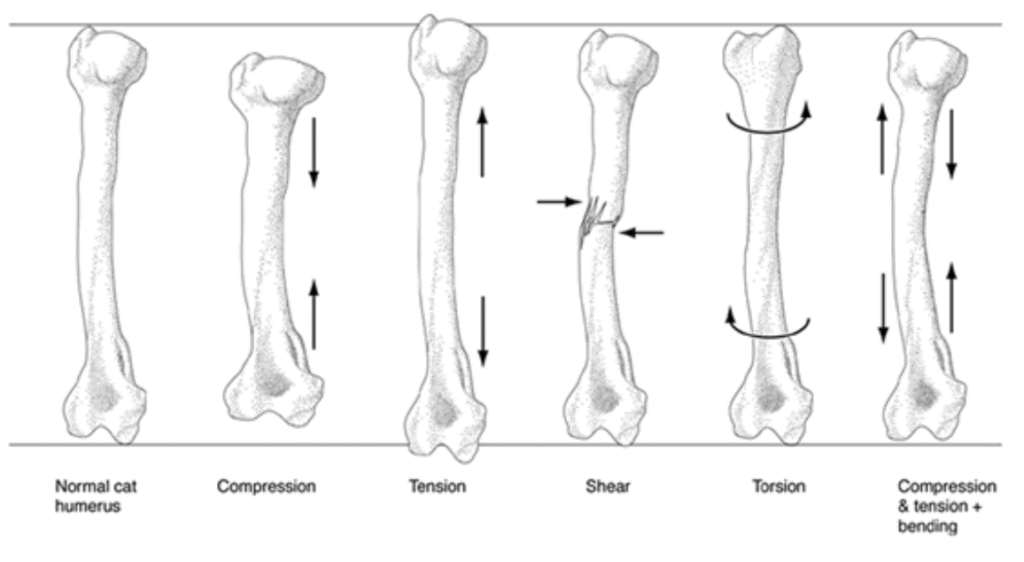
Forces in different directions
- Compression force
- Traction (tension)
- Shear force
- Torsional force (torsion)
- Inflection
Newton's principles
To understand forces and their effects on human movement, it helps to know the physical laws formulated by Sir Isaac Newton that govern the motion of all objects;
Inertia: Everything remains at the same speed and direction as long as no force acts on it. In other words, the force required to start an object in motion and to counteract or stop an object that is already in motion. A body's inertia is proportional to its mass. For example, if you are lifting weights, a heavier weight requires more force both to set it in motion and to slow or stop its motion than a lighter weight does.
Acceleration and momentum; F=ma Force depends on mass and acceleration. This law states that the force (F) acting on a body moving in a given direction is equal to the body's mass (m) multiplied by the body's acceleration (a): F = ma.
From this, we can see that the acceleration of a body is proportional to the magnitude of the force applied: a = F / m. So the acceleration of the body depends on how hard you push it, divided by its mass. The harder you push or pull something, the faster it will accelerate in the direction of the force. The second law also refers to the speed of a body. Linear or momentum is the amount of motion that a moving body has and is equal to its mass times its velocity. This means that a body's momentum can increase by increasing its mass or increasing its velocity. So when lifting a 10 kg weight and then a 20 kg weight at the same velocity, the 20 kg weight will have more momentum. Lifting a 10 kg weight at high speed requires more force than lifting the same weight at a lower speed, even if the resistance is the same. The more momentum increases, the more force is also required to stop or change direction. Momentum can be a positive force when playing sports such as soccer, where players race down the field and hope their opponents cannot match their speed. However, in progressive fitness training, your own body must be able to stop the speed you create. Excessive speed can cause injury, especially when working with weights; strength training should be performed at speeds that are under complete muscle control. In other words, if you "cheat" by initiating a movement with speed from a body part other than the one you are focusing on, the driving force in the moving neck/head may be greater than the muscle's ability to slow down and stop it.
The action-reaction principle: All forces acting on an object at rest are counteracted by an equal and opposite force. Thus, for every action there is an equal and opposite reaction. This law applies to forces that the body must absorb during activities such as running, jumping, and high-impact aerobics. Overuse and stress injuries can result from the body's inability to withstand impact and reaction forces. The impact on the feet and body increases rapidly, especially in larger individuals or during activities with high acceleration. The landing force is the body's mass (m) times its increased acceleration (a). The body exerts a force (m × a) on the ground, and the ground exerts an equal reactive force on the body, which must be dissipated through its shock-absorbing structures. Injuries often occur when the body is misaligned, so that the forces are not evenly distributed, or concentrated in tissues that are not designed to absorb such strong forces. This further explains why overuse and stress injuries can also occur in weight training where high speed is a factor: the force of tissues involved in stopping the movement must match the mass of the weight and the mass of the body segment multiplied by the acceleration of the weight and the body segment.
Examples of lever systems in the body
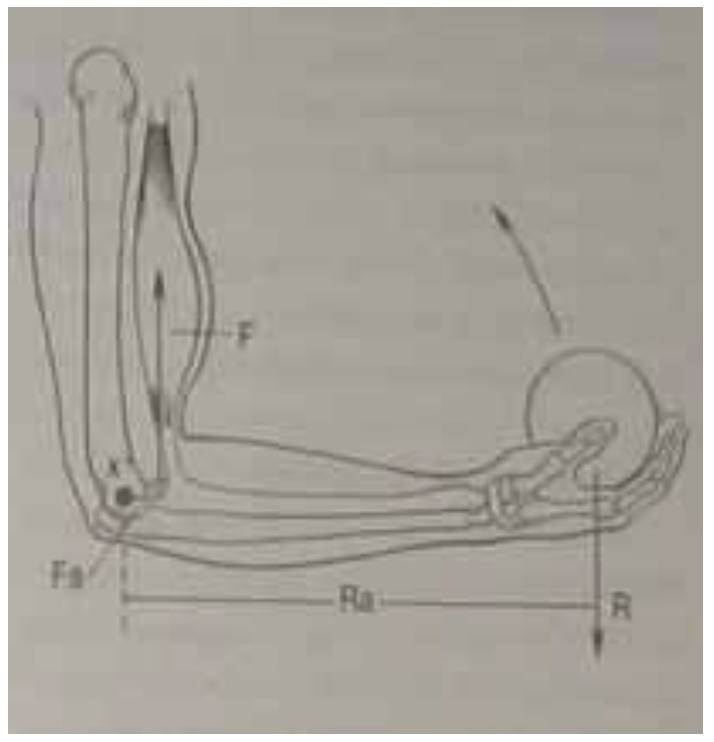
X = Rotation axis
F (Biceps shortening) = Driving force
R (Weight in hand) = Resistance force
Fa (Biceps force × length between biceps attachment and rotation axis) = Driving force lever arm
Ra (Weight × distance from rotation axis) = Resistance lever arm
When a force acts on a lever at some distance from the axis of rotation, the result is a twisting effect. This twisting is called torque. The magnitude of the driving torque is found by multiplying the amount of force by the length of the lever arm (the perpendicular distance from the axis of rotation). Therefore, F × Fa is the torque of the driving force (biceps), and R × Ra is the torque of the resistance. Rotation occurs in the direction that has greater torque.
Example calculation of drive torque
A client holding a weight in his or her hand is asked to hold it steady at a 90-degree angle of flexion in the elbow joint. The force from the weight and arm segment is considered to be 10 kg. The elbow flexors are considered to act at a perpendicular distance of 5 cm from the elbow joint. The length of the lever arm (weight + arm segment) is 38 cm. What is the torque of the elbow flexors in a balanced system?
To calculate the torque of the elbow flexors, use the following equation:
R × Ra = F × Fa
10 kg × 38 cm = 380 kg-cm
In a balanced system, the torque of the resistance and the torque of the elbow flexors would be equal to 380 kg-cm.
To answer the question of how much force must be generated to hold the 10 kg weight steady, solve for F:
Rx × Ra = F × Fa
10 kg × 38 cm = F × 5 cm
380 kg-cm = F × 5 cm
380 kg-cm / 5 cm = F
F = 76 kg
R = Resistance, Ra = resistance arm, F = driving force; Fa = force arm
Muscle power production
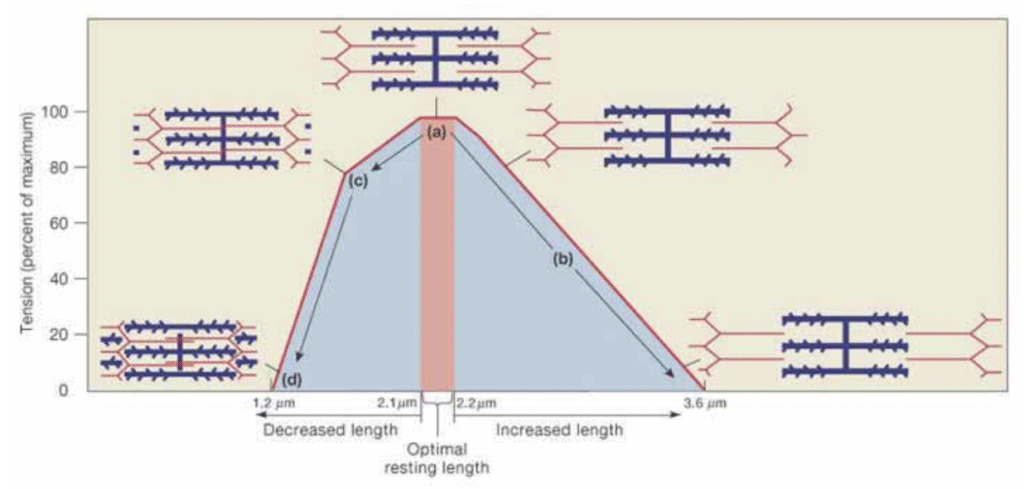
Fig. 1 Length-tension relationship . How the muscle generates force depending on its current length.
Muscle length-tension relationship
The muscle length-tension relationship is the relationship between the length of the fiber and the force that the fiber produces at that length. This length refers to the length of an isolated fiber and depends on the position of the actin and myosin filaments in the sarcomeres shown in the image above.
Power-Speed Curve
Fig. 2 Force-velocity relationship. How the muscle generates force in relation to contraction speed and type of contraction.
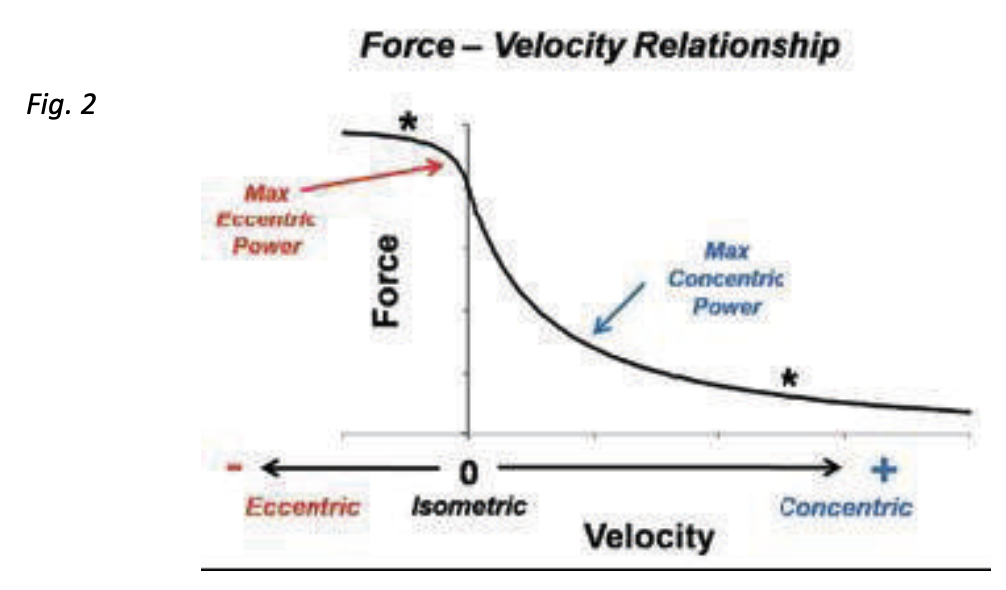
The force-velocity curve shown above illustrates the behavior of isolated muscle fibers. While most people assume that this relationship is preserved in muscle/sensory segments throughout the body, it is actually much more complicated than that. For example, there is evidence in certain movements that while the total length of the muscle increases (appearing to be an eccentric contraction), the muscle fibers are actually contracting concentrically (shortening), with the difference being made up by the elongation of the non-contractile parts of the muscle (tendon and connective tissue). Since power production is largely influenced by these structures, the reality is more complex than the classic force-velocity relationship.
Muscles and power production
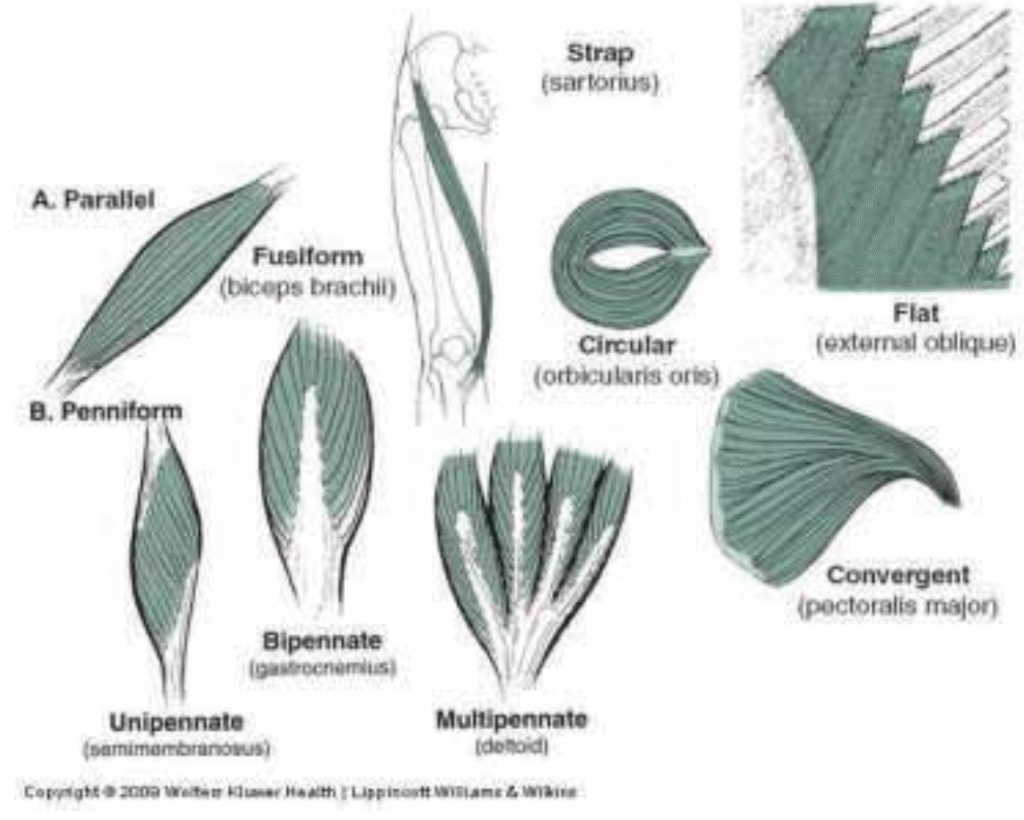
The number and size of muscle fibers, the type and shape of the fibers, and neurological training and recruitment are all factors that influence a muscle's ability to generate force. There are several types of muscle arrangements, including penniform (unipennate, bipennate, multipennate) and longitudinal (fusiform) muscles. Penniform muscles are designed for higher force production than longitudinal muscles. Most muscles in the body are penniform, with fibers lying obliquely in relation to the direction of pull, which is usually considered to be a straight line between the two attachment points of the muscle.
Peniform muscles allow a greater number of fibers to be packed into a given cross-sectional area, enabling more fibers to contribute to force production. The quadriceps is an example of a peniform muscle that can produce significant amounts of force, and its attachment points are relatively far from the movable joints.
Longitudinal muscles are long and narrow with parallel fibers running in the same direction as the muscle. This type of arrangement allows for rapid contractions, but because the cross-section is small, the contraction force is limited. Sartorius and Rectus Abdominis are examples of longitudinal muscles.
Anatomical, physiological, and biomechanical factors are important in determining the appropriate resistance for a client and when designing training programs. The structure of a muscle provides a lot of information about its primary function and how it should be trained.