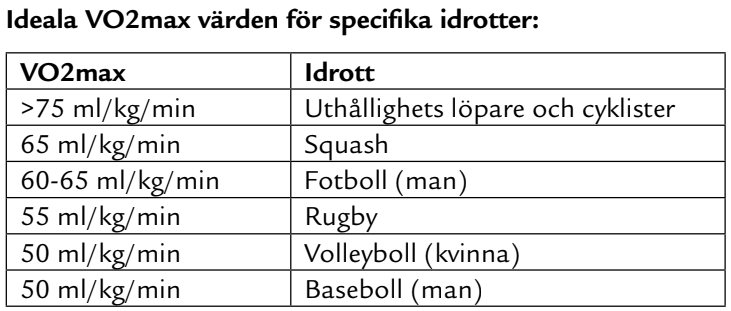
Fitness can be measured by the volume of oxygen you consume while exercising at your maximum level. VO2max is the maximum amount of oxygen in milliliters that can be used in one minute per kilogram of body weight. People who are well-trained have a higher VO2max value and can exercise more intensely than those who are not as well-trained. Several studies show that you can increase your VO2max by exercising at an intensity that raises your heart rate to between 65% and 85% of your maximum heart rate for 20 minutes, 3-5 times a week. The average value for male athletes is around 3.5 liters/minute and for women around 2.7 liters/minute.
The physical limitations that determine the extent to which energy can be released:
- The chemical ability of muscle cell tissue to use oxygen during the breakdown phase.
- The combined ability of the cardiovascular and pulmonary systems to transport oxygen to muscle tissue (
)
Improve VO2max
The exercises below are examples of exercises that increase oxygen uptake capacity:
- Run at maximum speed for 5 minutes. Let's assume that the distance is 1900 meters. Rest for 5 minutes and then run the same distance (1900 m) 20% slower, in other words in under 6 minutes, repeating this several times with 6-minute breaks in between. This is comparable to your 10-kilometer pace.
- Run at maximum speed for 4 minutes. We assume that the distance will be 1500 meters. Rest for 4 minutes. Now run the same distance 15% slower, in other words in 4.36 minutes, repeating this with 45 seconds of rest in between. This will be approximately halfway between your 5 and 10 kilometer pace.
- Run at maximum speed for 3 minutes. Let's say the distance is 1000 meters. Run the same distance about 10% slower, i.e. in under 3.18 minutes, repeatedly with 60 seconds of rest. This is in line with your 5-kilometer pace.
- Run at maximum speed for 5 minutes. Let's say the distance is 1900 meters. Rest for 5 minutes. Run the same distance 10% slower, repeating several times with 1.5 minutes of rest in between. This is your approximate 3-kilometer pace.
- Run at maximum speed for 3 minutes. We assume that the distance will be 1100 meters. After recovering, run the same distance 5% slower, i.e., 3.09 minutes repeatedly with a one-minute rest. This is comparable to your 3-kilometer pace.
When and how often?
It is recommended that examples 1 and 2 be done every week during the winter season and that examples 3-5 be done weekly during the bare ground season by runners who run 800 meters and above. New maximum tests should be performed at regular intervals, for example seasonally, to set the level for continued training. These maximum efforts are, of course, high-quality training in themselves. If the heart rate has not recovered to 120 beats per minute within the specified recovery time, the recovery period should be extended before the next repetition begins. The recovery time between repetitions should be timed and kept accurately. When all five occasions/tests have been completed within a month, experience shows a significant improvement in performance.