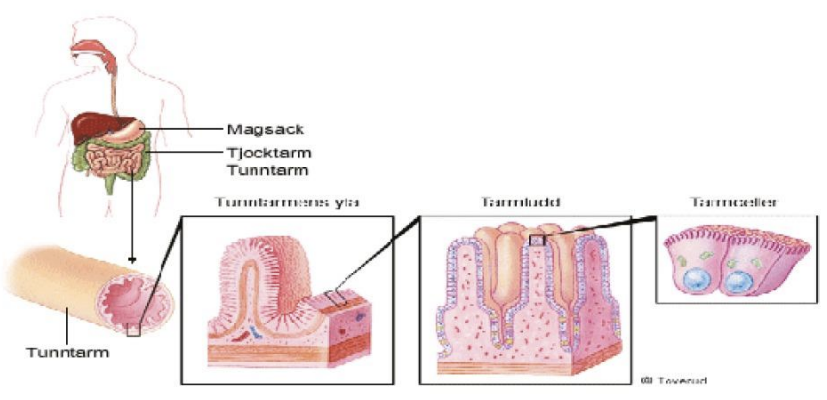
It is about 4 meters long. It is divided into the duodenum, jejunum, and ileum.
The mucosal wall here is highly folded, which results in an enormous surface area. The surface area itself is further increased by so-called villi, which are projections 0.5–1.5 mm long. These villi contain cells that, in turn, have multiple projections. These projections are called microvilli. The total surface area is then 300 m²! Highly efficient absorption!!
When hydrochloric acid enters the duodenum, the hormone secretin is released. This stimulates the pancreas, which begins to secrete a thin, watery fluid that neutralizes the hydrochloric acid. Through the hormone pancreozymin, the pancreas then begins the slower production of enzymes involved in the breakdown of proteins, carbohydrates, and fat.
The stomach and pancreatic juices then also come into contact with the “food bolus.” Bicarbonate from the pancreatic juice makes the mixture alkaline, allowing the pancreatic enzymes to continue breaking down the food through chemical digestion.
Enzymes from the pancreas:
- Amylase breaks down carbohydrates
- Lipase breaks down fat
- Trypsin breaks down protein
Bile is required for the activity of fat-digesting enzymes. Bile contains bile salts that emulsify fat into small droplets so that lipase can break it down. Fatty food in the intestine stimulates the production of the hormone CCK (cholecystokinin), which causes the gallbladder to empty its contents into the duodenum.
The functions of the small intestine are:
- To continue breaking down the food
- To absorb water and nutrients from food.
Every day, the small intestine receives six to seven liters of fluid. This consists partly of the food and liquids we have eaten and drunk, and partly of fluids produced in the gastrointestinal tract—namely, saliva, gastric juice, bile, and pancreatic juice.
In the small intestine, an additional two liters of fluid are added in the form of intestinal juice. Intestinal juice contains digestive enzymes, as well as water and mucus that lubricate the intestine and facilitate transit. Of the eight to nine liters of fluid that pass through the small intestine, the vast majority is reabsorbed. Most of the fluid is absorbed in the small intestine, and some of it in the large intestine. Just under two deciliters of fluid leaves the body every day along with the stool.
By the time food reaches the small intestine, it has already been broken down and digested into its smallest components. This is where the next important step begins—absorbing the nutrients the body needs: sugar, fat, and amino acids.
They are absorbed through the intestinal lining and enter the blood vessels in the intestinal wall. They are then transported to the liver, where they are either used to produce various substances or stored. The small intestine also absorbs vitamins and minerals.
What remains of the intestinal contents leaves the small intestine after three to five hours. It is necessary for the passage through the small intestine to take quite a long time so that all the essential nutrients have time to be absorbed.