
Food that has not yet been broken down and absorbed reaches the large intestine within 2–7 hours.
Only a very small portion of the nutrients is absorbed here. It is mainly salts and water that are absorbed. Water is absorbed in significant quantities.
Some breakdown of dietary fiber occurs here with the help of billions of bacteria found in the intestine, which are part of the intestinal microbiota. As these bacteria break down the fiber, gases are produced as a result of their activity. These gases are CO2, methane, and hydrogen.
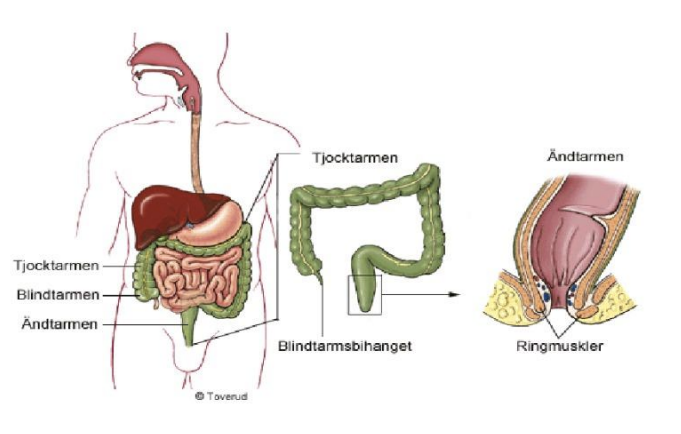
Lactic acid bacteria and dietary fiber appear to have a positive effect on the bacterial composition. The large intestine receives one to two liters of digestible material each day. This material remains in the large intestine for three to ten hours. It is transported downward through the intestine by peristaltic movements caused by the contraction of the intestinal muscles.
The lower part of the rectum is widened and can therefore collect some stool before the bowel needs to be emptied. Around the opening of the rectum are two ring-shaped muscles, known as sphincter muscles, one of which can be controlled voluntarily. A reflex is triggered, causing the colon and rectum to contract in order to expel the stool