
CUTTING AND PLANTING TERMS/ POSITION TERMS
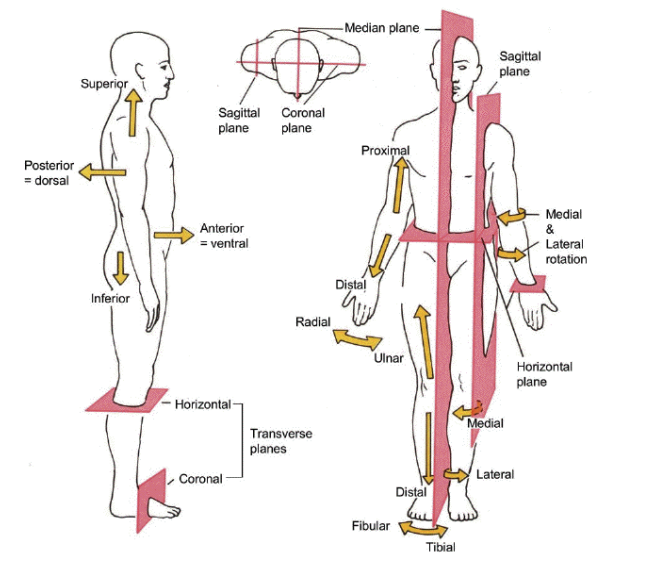
TERMS OF REFERENCE
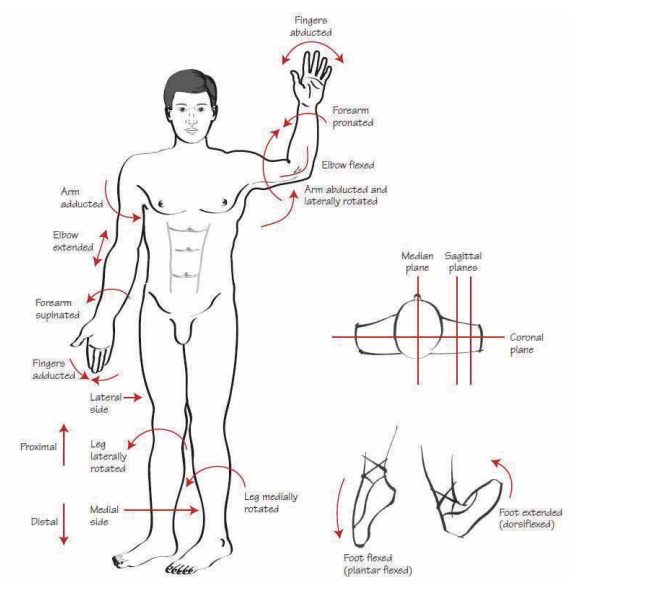
Describes the body's various movements.
Flexion – bending
Extension – stretching
Lateral flexion – sideways bending of the torso and neck/head
Abduction – outward movement (of extremities)
Adduction – inward movement (of extremities)
Rotation – inward or outward turning
Palmar flexion – the hand bends toward the palm
Plantar flexion – the foot bends toward the sole
Dorsal flexion – the hand and foot bend toward the back of the hand and the sole, respectively
Supination – the palm faces upward or the sole of the foot turns inward
Pronation – the palm faces downward or the sole of the foot turns outward
The musculoskeletal system comprises the skeleton, bones, joints, and skeletal muscles.
The skeleton
The skeleton consists of approximately 206 bones, whose function is to protect our internal organs, stabilize the body, store minerals, form blood cells, and act as levers and attachment points for skeletal muscles. The body has approximately 300-400 skeletal muscles that work together in various voluntary movements. The skeleton is formed as connective tissue during fetal life and gradually calcifies. Bone tissue is an active tissue and turnover occurs through bone-forming cells (osteoblasts) and bone-degrading cells (osteoclasts). Due to the high turnover of bone mass, there is a very good healing capacity in the event of injuries such as fractures.
A prerequisite for a stable skeleton is that metabolism is carefully regulated. Several hormones, such as estrogen, growth hormone, cortisol, calcitonin, and parathyroid hormone, control bone metabolism. There are several different types of bones, which are named after their appearance:
- Bones (e.g., skeleton in arms and legs)
- Small dice-shaped bones (e.g., the small bones of the hand and foot)
- Flat bones (e.g., sternum)
- Irregular bones (e.g., vertebrae)
There are also different types of bone, such as compact bone and cancellous bone. Compact bone is very wear- and compression-resistant, and this bone forms the hard outer layer of the bones. Cancellous bone is elastic and weight-saving, and this is found inside the compact bone.