
The connection between two bones can be of two different types. Either it is movable, in which case it is called a joint, or it is largely immovable, in which case it is called a suture. Depending on the shape of the joint surfaces, certain movements will be possible in a joint, while other movements will be completely prevented. There are seven different types of joints in total.
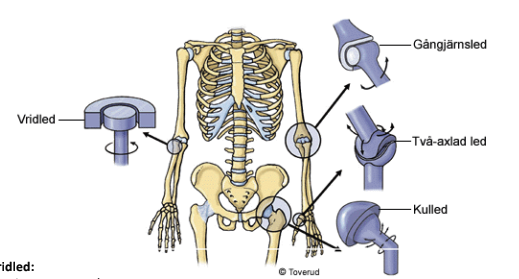
Twist joint:
Movement: Pronation/Supination
Rotation
Position: Elbow joint & C1-C2
Hinge joint
Movement: Flexion & Extension
Location: Elbow joint & Knee joint
Kulled
Movement: Flexion, Extension, Abduction, Adduction & Rotation
Location: Hip joint & Shoulder joint
Two-axle joint (Egg joint & Saddle joint)
Movement: Flexion/Extension & Abduction/Adduction
Stiff joints are not shown in the image; joints with very limited range of motion, e.g., the sacroiliac joint (art. sacro-iliaca).
A joint is surrounded by a joint capsule (synovia). It encloses the joint and is reinforced by strong tendons and ligaments. The ends of the bones in a joint are covered by articular cartilage (cartilago articularis), which smooths the surfaces and reduces friction between the joint surfaces. Between the articular cartilage is the joint space, which contains synovial fluid. The synovial fluid lubricates the joint, reduces friction during movement, and supplies the articular cartilage with oxygen and nutrients. In certain joints, such as the knee and jaw joints and in the spine, there are cartilage discs between the joint surfaces, known as discs or menisci. These help to distribute the pressure in the joint, thereby reducing stress. Our joints vary greatly in terms of load-bearing capacity and mobility. The more mobile a joint is, the more unstable it becomes, e.g., the shoulder joint, which dislocates more often than others.