
Below is an explanation of how to use a caliper.
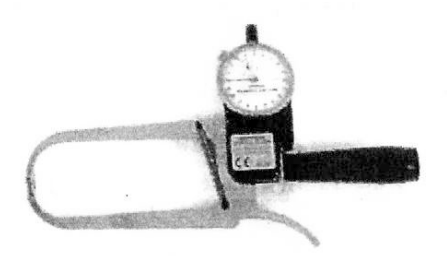
The Harpenden Skinfold Caliper HSK-BI- By British Indicators
Thank you for purchasing our product. We are confident that you have chosen one of the most up-to-date and versatile skinfold calipers on the market. Used correctly, it will give you good service and reliable results for many years! In order to obtain optimum results, we strongly suggest that you read your manual thoroughly, even if you have experience in using this type of equipment. Details of our related products can be obtained directly from British Indicators. The carry case should contain one Harpenden Skinfold Caliper instrument and one copy of this handbook.
Contents
- Body Composition – Its evaluation and meaning
- Setting and using the Harpenden Skinfold Caliper
2.1 Care and use
2.2 Setting the Caliper - Taking the skinfold measurements
3.1 Equipment required
3.2 Correct technique - Site selection
4.1 The 4 Site System for male and female subjects
4.2 The 3 Site System for male
4.3 The 3 Site System for female - Maximum desirable fat percentage – preferred levels and normality
5.1 Male subjects
5.2 Female subjects - Body Density Equations
1. Body Composition – Evaluation and meaning
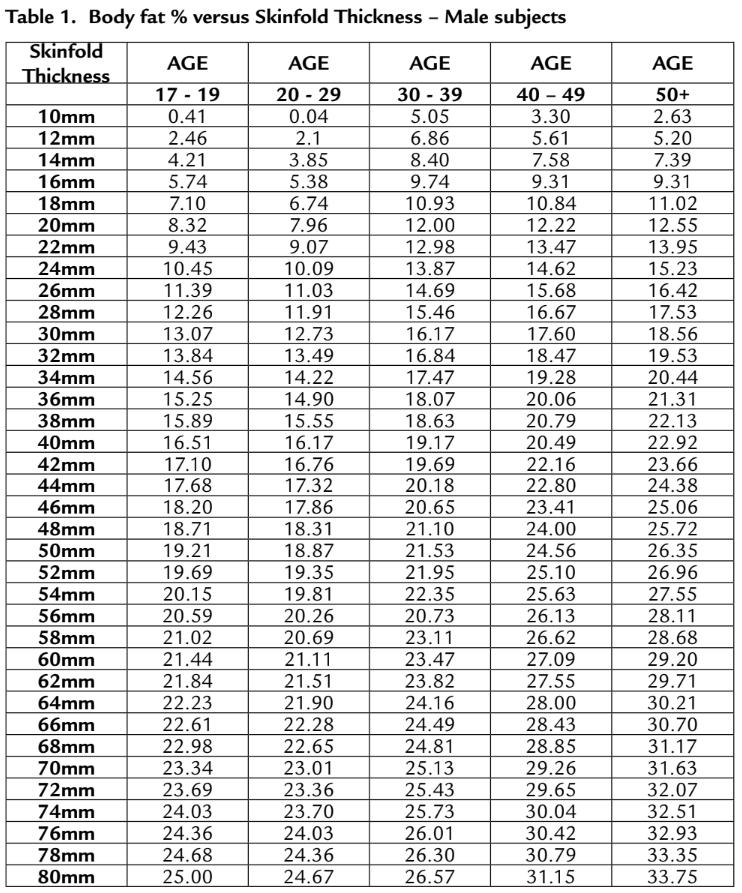
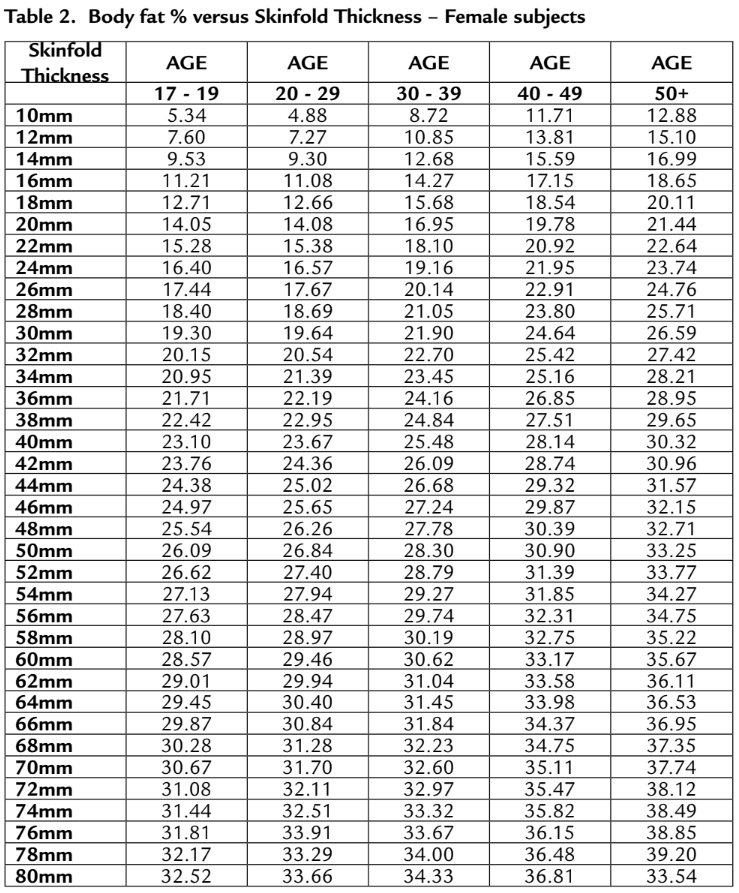
The most accurate estimation of body composition is achieved by use of the underwater or hydrostatic weighing technique. Obviously this method places severe restrictions on both practicality and convenience, and the alternative basis of skin fold thickness measurements is therefore used in all but the most stringent of requirements. The use of skin fold calipers in the performance of skin fold thickness measurements (from which estimates of body fat are derived) has been well established and documented over the last 40 years, references to which can be found in the Bibliography section of this manual. These thickness measurements do not measure overall body fat mass or its percentage directly but rely on validated equations that describe the relationship between measures of skin fold fat as well as other body dimensions and the measured body density. Various experimenters have put forward equations that are used with either skin fold thickness alone or in conjunction with other measurements such as body circumference or limb lengths. Two of the most common sets of equations used are attributable to Dumin & Womersley (skin folds alone) and to Jackson & Pollock (skin folds and body measurements). The result obtained from the equations (that of body fat density) is subsequently used in the SIRI Equation to calculate body fat. Tables are included that show the fat percentage based on the Dumin & Womersley system. Values are shown for both males and females across the entire age range based on the sum of 4 skin fold measurements and the results shown for each 2-millimeter increment of skin fold thickness. Skin fold measurements, when taken correctly, correlate very highly (0.83 to 0.89) with hydrostatic weighing, with a standard error of only about 3 or 4%. In comparison, the correlation of height and weight charts is much lower at about 0.60. The explanation of the use of skin fold thickness measurement in the derivation of body fat data has been simplified enormously and can never detract from the tremendous volume of research and scientific ability in the fields of both nutrition and fitness. We all owe much respect and our considerable thanks to the specialists responsible for guiding us towards a healthier life worldwide.
2. Setting and using the Harpenden Skinfold Caliper
- Care and use
- Ensure that your caliper is clean and opens freely and smoothly. Always clean the caliper before and after use on a test subject.
- Open the caliper to approximately 20 mm and allow it to close several times.
- Check for repeatability of the zero reading within one division (0.2 mm)
- Do not open and close the caliper rapidly or allow the caliper to snap shut. This can cause damage to the indicator mechanism.
- When taking measurements, do not allow the caliper to snap shut onto the test subject as this could cause discomfort.
- Setting the Caliper
- To reset the dial indicator to zero, rotate the bezel to the appropriate position.
- The caliper is now ready for use.
- To calibrate the Harpenden Skinfold Caliper, a special Calibration Kit can be purchased.
3. Taking the skinfold measurements
The accuracy of measurements is, as one would expect, dependent upon the accuracy of the equipment being used, the correct selection and location of the skinfold sites, the proper technique in taking the measurements, and the experience of the user.
Equipment needed
A Tape Measure – to help find the right spot Skinfold Caliper – Accurately calibrated and with a constant spring pressure of 10g/mm2 throughout its entire range. Your Harpenden Caliper has been calibrated to this performance before leaving the factory
Correct technique
Essential for accurate and repeatable tests, specific guidelines for taking skinfold measurements have been established. Following a standard method of assessment helps ensure accuracy and repeatability on future testing.
a) Measurements should be taken on healthy, undamaged, and uninfected dry skin. Moist skin is harder to grasp and can influence the measurement. Do not use the caliper on broken or infected skin.
b) Instruct the test subject to keep the muscles relaxed during the test.
c) Take all measurements on the right side of the body. An exception might be where a deformity or missing limb would necessitate using the left side.
d) Mark the skinfold site using a pen with water-soluble ink. Use a tape measure to accurately find the midpoints.
e) The skinfold should be firmly grasped by the thumb and index finger, using the pads at the tip of the thumb and finger. Gently pull the skinfold away from the body.
f) The caliper should be placed perpendicular to the fold, on the marked site, with the dial approximately 1 cm below the finger and thumb. While maintaining the grip on the skinfold, allow the caliper to be released so that the full tension is placed on the skinfold. The dial should be read to the nearest 0.55 mm, 1 to 2 seconds after the grip has been fully released.
g) The caliper should not be placed too close to the body or too far away on the tip of the skinfold. Try to visualize the location of a true double fold of skin thickness and place the caliper there.
h) At least two measurements should be taken at each site. If repeated tests vary by more than 1 mm, repeat the measurements. If consecutive measurements become consecutively smaller, the fat is being compressed. Go to another site and come back a little later and recheck the problem site.
i) The final value recorded should be the average of the two that seems best to represent the skinfold fat site.
j) Record each skinfold as you measure it. It is easy to forget the first measurement if you try to keep it all in your head.
k) Experience is necessary to consistently grasp the same size skinfold in the same location. Practice these techniques until you get consistent results.
4. Site Selection
4.1 The 4-site system for male and female subjects
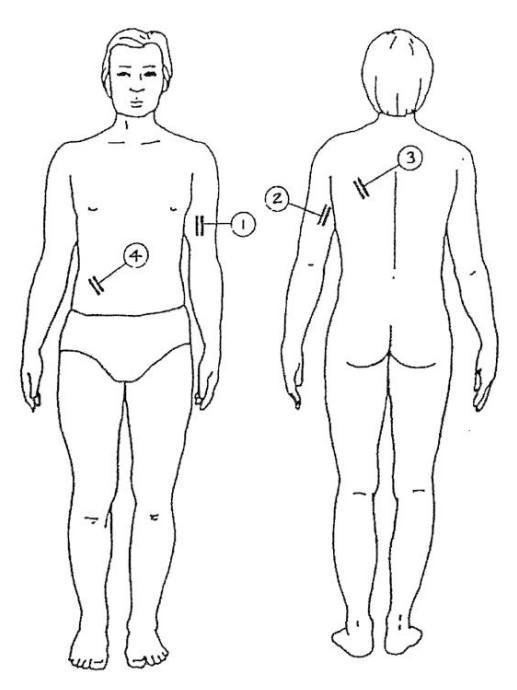
4.2 The 3 Site System for male subjects
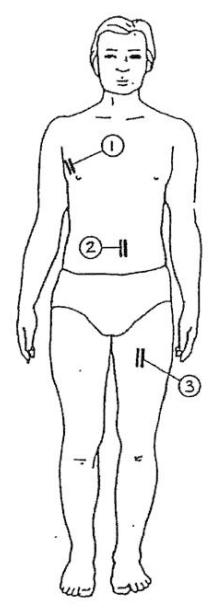
Site 1) CHEST (Juxta-nipples)
A diagonal fold taken one half of the distance between the anterior auxiliary line and the nipple. (The anterior auxiliary line is the crease
where the top of the arm, when hanging down, meets the chest)
Site 2) ABDOMINAL
The vertical fold taken at the lateral distance of approximately 2 cm from the umbilicus (2 cm to the side of the umbilicus)
Site 3) THIGH
A vertical fold on the front of the thigh, halfway between the hip and knee joints (on the front of the thigh halfway between the hip joint, where the leg bends when the knee is lifted, and the middle of the knee cap). The leg should be straight and relaxed.
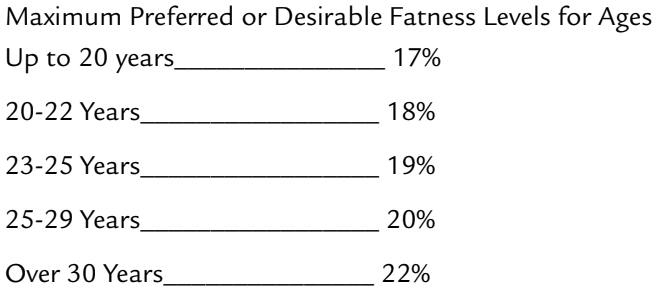
5. Maximum desirable fat percentage – Preferred levels and normality
5.1 Male Subjects
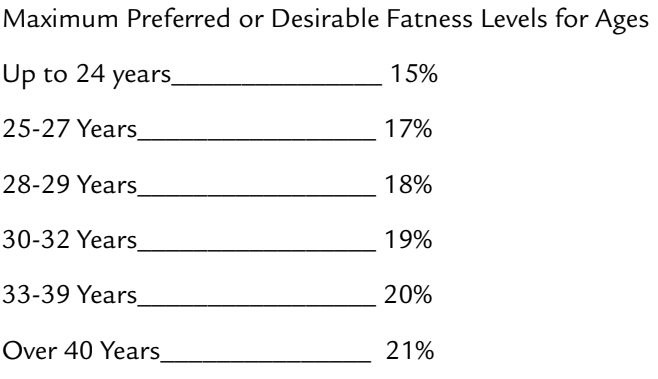
The levels recommended are based on a recent population survey of 9000 individuals performed by Dumin et al (1985) as well as the consensus of previous opinion (Katch and McArdle (1973), Dumin and Rahaman (1967) and Royal College of Physicians (1983). The maximum levels are age and sex dependent, reflecting an increased risk of morbidity and heart disease in males if they are fat and young (Van Itallie (1979)), but allowing for a greater fat mass (25%) as the age of men increases to 40 years and beyond. A more preferable level would be 4-5% lower (i.e., 20%), and this should be sought. Younger men under the age of 20 should have a preferred value of 15% or lower, and there is a sliding scale of maximum fatness from the early twenties to the forties and beyond.
5.2 Female Subjects
The average fat content for women is between 24 and 25%, depending on country of residence, although from a health point of view, a maximum desirable level of 30% (young) and 35% (older) may pose no threat. This level of moderate obesity would not satisfy the desirable shapes or quirks of contemporary fashion. The fashion model type of body composition reflects a fat percentage of 15% or less, female gymnasts as low as 8%, and distance runners down to 6%. The maximum desirable level suggested is based on the work of Katch and McArdle (1973), Pollock et al (1975) and Brown & Jones (1977) and is 25% for women aged 30 and over, but starts at 20% for those under 20 years old. Again, there is a sliding scale reflecting advancing age and a reduction in health risk. Contemporary fashion would indicate a preferred female level of perhaps 3% lower than these values.
6. Body Density Equations
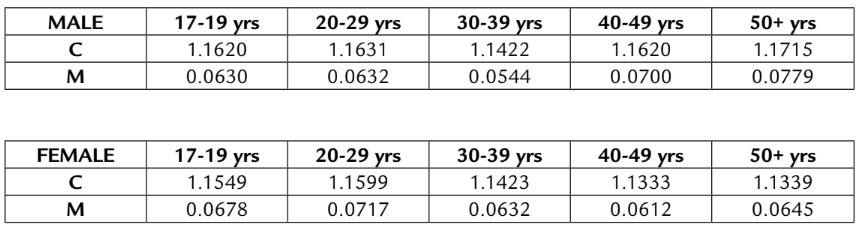
Linear Regression Equations (Durnin & Wormersley)
Body Density = C-(M(Log10 sum of all four Skinfolds)
The Siri Equation
FAT% = [(4.95/BD) – 4.5] x 100
Body Density Equations (Jackson & Pollock)
MALE BD = 1.0990750 – 0.0008209(X2) + 0.0000026(X2)2 – 0.0002017(X3) – 0.005675(X4) + 0.018586(X5)
Where:
X2 = sum of the chest, abdomen and thigh skinfold in mm
X3 = age in years
X4 = waist circumference in cm
X5 = forearm circumference in cm
FEMALE BD = 1.1470292 – 0.0009376(X3) + 0.0000030(X3)2 – 0.0001156(X4) + 0.0005839(X5)
Where:
X3 = sum of triceps, thigh, and suprailiac skinfolds in mm
X4 = age in years
X5 = gluteal circumference in cm