
The heart, which occupies most of the mediastinum, is enclosed within the pericardium. The heart is a hollow muscle divided by partitions (septa) into four chambers: two atria, which receive blood, and two ventricles, which pump blood into the pulmonary and systemic circulatory systems.
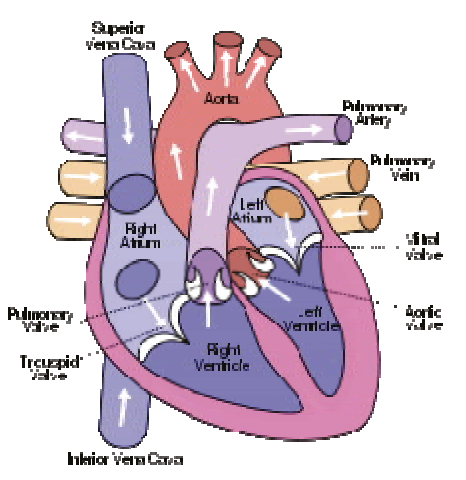
The heart functions as a double pump and can be divided into the right side of the heart (right atrium and right ventricle) and the left side of the heart (left atrium and left ventricle). The left ventricle, which pumps blood into the systemic circulation, works against high blood pressure and therefore has a significantly thicker muscle wall than the right ventricle. To control blood flow from the atria to the ventricles and prevent backflow of blood, there are valves (semilunar valves) between these chambers that function as one-way valves. To similarly prevent backflow of blood into the ventricles after ejection through the aorta or the pulmonary artery, there are special valves (semilunar valves) at the exit of these vessels.
The heart’s pumping action is usually divided into two main phases: a contraction phase and a relaxation phase. During the contraction phase (systole), the ventricular muscles contract and blood is pumped out into the aorta and the pulmonary artery. After systole, the heart enters its relaxation phase (diastole), during which the ventricles refill with blood.