Energy consumption
The body requires energy for all physical activity. The amount of energy consumed depends on the duration and type of activity. Energy is measured in calories (kcal) and is taken from the body's reserves and from the food we eat. Below you can read more about energy consumption when walking and running.
Walk
Walking is our main physical activity. There is a linear relationship between walking speeds of 3-5 km per hour and oxygen uptake, but at higher speeds, oxygen consumption increases. This makes walking less economical from an energy consumption point of view. Body weight in kilograms can predict approximate energy consumption at speeds of 3.2-6.4 km/hour. The table below shows how many calories you burn per minute, depending on your body weight and speed, when walking on a flat surface, such as asphalt, gravel, grass, and a running track.
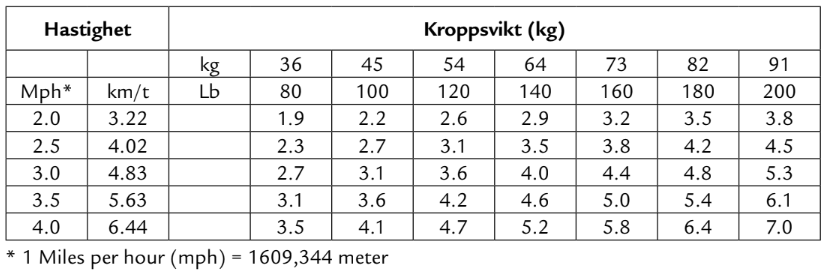
If you weigh 64 kg and walk at a speed of 5.63 km/h, you will burn approximately 4.6 calories per minute. Walking for an hour will therefore burn around 276 calories (60 minutes x 4.6 kcal/min = 276 kcal).
Running
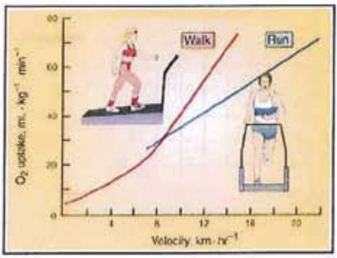
At the same speeds, a regular distance runner runs with a lower percentage of aerobic capacity than an untrained runner, even though oxygen uptake (O2) during the run is the same for both of them. The distinction between running and jogging depends on the individual's fitness level. Regardless of fitness level, it is significantly more economical from an energy perspective to switch from walking to running when your speed reaches 8 km/h.
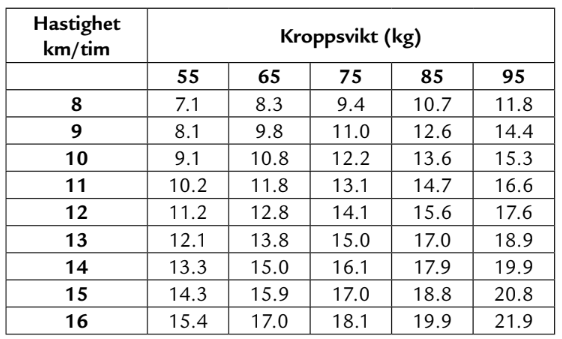
At this limit, the walker's oxygen uptake exceeds that of the runner. At 10 km/h, the walker's oxygen uptake is 40 ml/kg/min compared to 35 ml/kg/min for the runner. Body weight can predict energy consumption fairly accurately for running on flat ground. The number of calories burned during one kilometer of running is related to your weight in kilograms. A 78 kg runner burns 78 kcal/hour. This means 15.6 liters of oxygen (O2) per kilometer (1 liter of oxygen = 5 kcal). The table shows an estimate of the number of calories you will burn per minute, based on your body weight and speed when running on a flat surface.
Comparing exercise
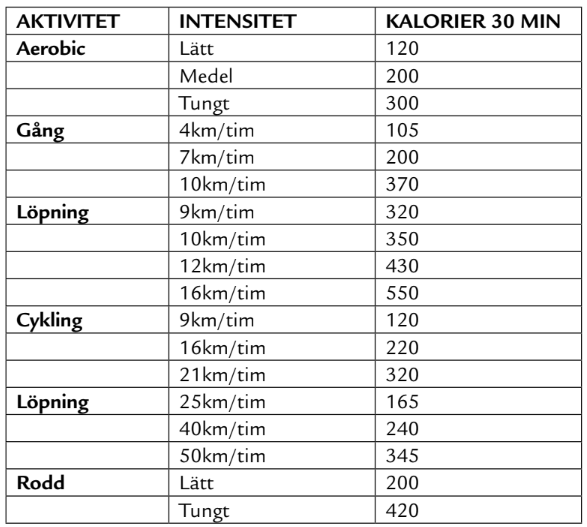
The table below shows the approximate number of calories burned during 30 minutes of various exercises and intensities for a person weighing 68 kg.
Energy pathways
Energy production is both time and intensity related. Running at high intensity, sprinting, means that an athlete can keep going effectively for only a short period of time. Running at low intensity, such as regular jogging, means that the athlete can sustain activity for a longer period of time. With the right training, you can change these "patterns," making the sprinter run for a longer period of time and the endurance athlete maintain high intensity for a certain amount of time. There is a relationship between training intensity and energy source. In the book "The Physiological Education of Athletics," the authors divide types of running into the following "energy pathways": ATP-PC and LA, LA-02 and 02, which are explained below.
ATP – Adenosine Triphosphate
A complex chemical mixture formed from the energy released from food and stored in all the body's cells, mainly in the muscles. Only with the energy from this mixture can the cells work and perform. The breakdown of ATP produces energy and ADP.
PC – Phosphate-creatine (Creatine phosphate)
A chemical compound stored in muscles, which contributes to the creation of ATP when broken down. The combination of ADP and PC produces ATP.
LA – Lactic Acid
LA is an exhausted metabolite (breakdown product) and the result of the incomplete breakdown of glucose. However, it has been discovered that although very intense lactic acid production is part of the exhausting process, it is primarily the protons that are formed at the same time that set limits on continued performance.
O2
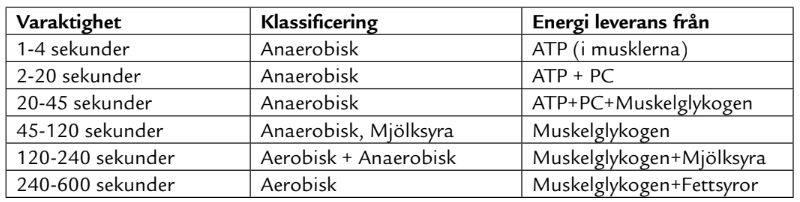
Refers to an aerobic process in which ATP is produced from our food, primarily sugar and fat. This system produces ATP in incredible amounts and is the primary source of energy during endurance-based activities. These energy pathways are time-limited. In other words, once a certain amount of time has passed, that specific energy source is no longer used. Scientists disagree on these limits, but the general consensus is as follows:
Muscle contraction produces ADP, which interacts with PC to regenerate ATP. PC is stored in the muscles. Actively contracted muscles obtain ATP from glucose stored in the body's bloodstream and from the breakdown of glycogen stored in the muscles. Training over a longer period of time requires complete oxidation of carbohydrates or fatty acids in the mitochondria. Carbohydrate reserves last for about 90 minutes, while fatty acid reserves last for several days.
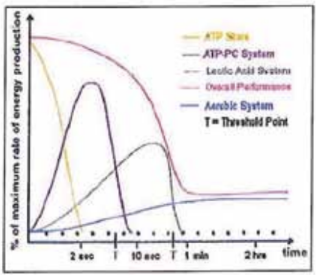
All three energy systems contribute at the beginning of a training session, but the extent of their cooperation varies from individual to individual and is determined by the intensity of the training and the rate at which energy is used. The diagram shows how the energy systems together contribute to the production of ATP at maximum training intensity. The threshold (T) shows at what point each energy system is exhausted – the right training extends the "threshold times."
The anaerobic energy system (ATP-CP)
Adenosine triphosphate (ATP) stored in the muscles lasts for approximately 2 seconds. The regeneration of ATP from creatine phosphate (CP) continues until the C stores are depleted, which takes around 4-5 seconds. This gives us approximately 5-7 seconds of ATP production.
Developing this system requires high-intensity work, close to maximum level for periods of 4-7 seconds. Examples of this are:
- 3x10x30 meters with 30 seconds rest/rep and 5 minutes/set.
- 15×60 meters with 60 seconds rest
- 20×20 meter interval running with 45 seconds of rest.
The anaerobic lactic acid system
As soon as CP stores are depleted, the body uses stored glucose for ATP. The breakdown of glucose or glycogen under anaerobic conditions results in the production of lactate and hydrogen ions. The accumulation of these ions is the determining factor for fatigue in races between 300 and 800 meters.
Examples for developing this energy system:
- 5-8 x 300 meters fast with 45 seconds rest (until your heart rate clearly slows down/drops)
- 150-meter intervals at 400-meter pace/distance, 20 seconds rest (until heart rate clearly decreases)
- 8 x 300 meters with 3 minutes rest
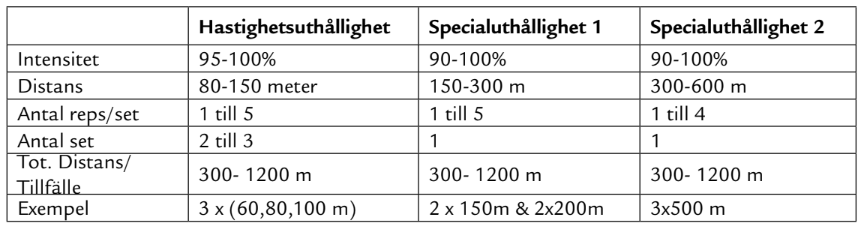
There are three different work units within this system:
a) Speed endurance
b) Special endurance 1
c) Special endurance 2
All three can be developed using the following methods:
The aerobic energy system
The aerobic energy system uses proteins, fats, and carbohydrates (glycogen) to restore ATP
. This energy system can be developed at varying rates during a race:
- Continuous pace
Slow running for a long period of time at 50-70% of maximum heart rate. The normal response from the system is to increase the capacity of the muscles and liver glycogen, as well as the glycolytic activity within this process. - Extensive tempo
Continuous running at 60-80% of maximum heart rate. Running in this way contributes to the removal and turnover of lactate and the body's ability to tolerate higher levels of lactic acid. - Intense pace
Continuous runs at 80-90% of maximum heart rate. Lactic acid levels increase when runs border on speed endurance and special endurance. This type of training at an intense pace lays the foundation for the development of the aerobic energy system. To develop aerobic energy systems:- 4-6 x 2-5 minutes of running with 2-5 minutes of rest
- 20 x 200 meters with 30 seconds rest
- 5-10 kilometers of running
The recovery of energy systems
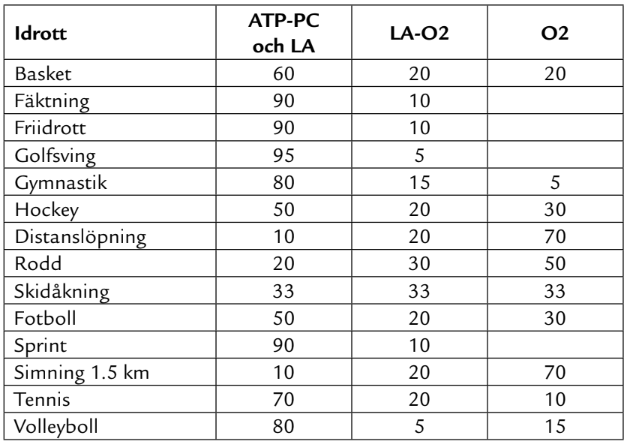
Even though all energy systems essentially "kick in" at the same time, the recovery of an alternative system occurs when the current energy system is essentially depleted. The table below shows the approximate contribution of each energy pathway in specific sports: