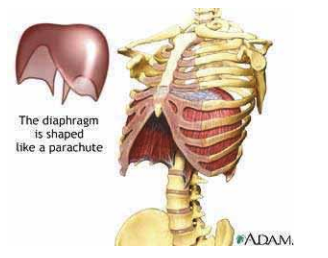
Chest muscles
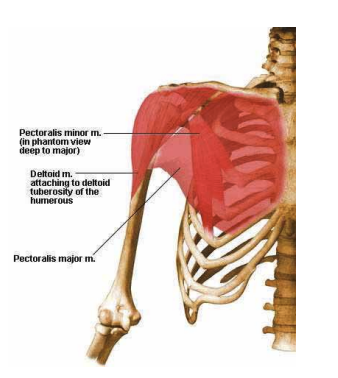
M. Pectoralis major (pectoralis major muscle)
Origin: medial half of the clavicle, sternum, cartilage, ribs 1–6
Insertion: crista tuberculi majoris humeri
Function:adduction, internal rotation, and flexion of the arm
M. Pectoralis minor (small pectoral muscle)
Origin: costal ribs 3–5
Insertion: coracoid process of the scapula
Function: accessory respiratorymuscle ; depresses the shoulder girdle
M. Deltoideus (deltoid muscle)
Origin: scapula and clavicle
Insertion: deltoidtuberosity
Function: external rotation , internal rotation, abduction, adduction, flexion, and extension of the arm
Shoulder blade muscles (rotator cuff)
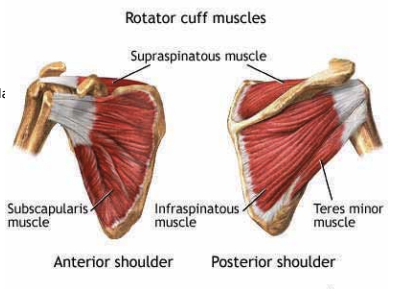
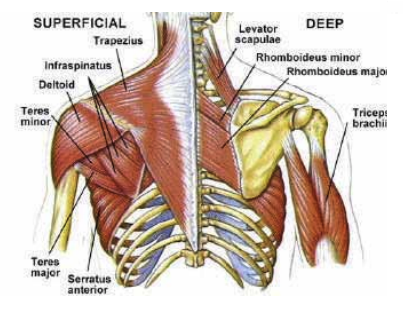
Subscapularis
Origin: Fossa subscapularis (anterior part of the scapula)
Insertion: Tuberculum minus humeri
Function: Internal rotation of the shoulder joint
Infraspinatus
Origin: Fossa infraspinata (hereinafter spina scapulae, posterior to the scapula)
Insertion: Tuberculum majus humeri
Function: External rotation of the shoulder joint
Teres Minor
Origin: Lateral part of the scapula
Insertion: Greatertubercle of the humerus
Function: External rotation of the shoulder joint
Supraspinatus
Origin: Fossa supraspinata (fossa above the spine, posterior to the scapula)
Insertion: Tuberculum majus humeri
Function: Abduction (the first phase of the movement) and external rotation of the shoulder joint
Teres Major
Origin: Lower lateral border of the scapula
Insertion: Crista tuberculi minoris (bone ridge below the tubercle minor)
Function: Internal rotation and adduction of the shoulder joint (Not normally considered part of the rotator cuff)
Rhomboideus major
Origin: Spinal processes of the Th1–Th4 vertebrae (5)
Insertion: Medial border of the scapula
Function: Adduction and elevation of the scapula.
Rhomboideus minor
Origin: Spinal processes of vertebrae C7–Th2 (superior to the rhomboid major)
Insertion: Medial border of the scapula
Function: Adduction and elevation of the scapula.
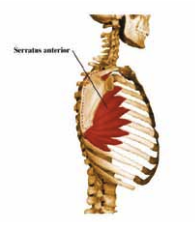
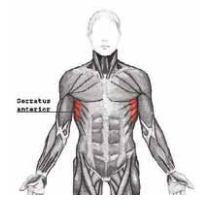
Serratus anterior
Origin: 1st–9th ribs, anteriorly and laterally on the thorax
Insertion: Medial , anterior scapula
Function: Pulls the scapula toward the thorax and anteriorly/caudally (downward). The serratus muscle assists, among other things, in raising the arm beyond 90 degrees.
Diaphragm (the large breathing muscle)
Origin and insertion in the vertebral bodies, ribs, and sternum.
Function: Moves downward during contraction, thereby increasing the volume of the chest cavity.
The diaphragm is the most important respiratory muscle.