
The Circulatory System
The circulatory system plays a role both in transporting blood and in the exchange of various substances between the blood and interstitial fluid.
The Structure of Blood Vessels
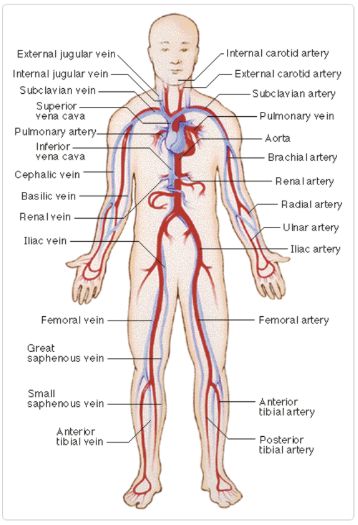
Blood vessels that carry blood away from the heart are called arteries, and those that carry blood back to the heart are called veins. Between the arteries and veins are small blood vessels called capillaries, and it is there that the main exchange of various substances takes place. Sometimes, a further classification of blood vessel types is made, distinguishing between arterioles (small arteries found between arteries and capillaries) and venules (small veins found between veins and capillaries). For example, a red blood cell leaving the heart passes, in that order, through an artery, an arteriole, a capillary, a venule, and finally a vein.
The structure of blood vessels varies greatly depending on their function. Arteries, which must withstand high pressure, have thick walls and often contain a large amount of smooth muscle (non-voluntary muscle). The wall of a capillary consists of only a single layer of cells, which is very thin and allows for the exchange of nutrients and gases between the blood and tissue fluid. Veins have thinner walls and a larger lumen (inner diameter) than the corresponding arteries.
Anatomy of the Circulatory System
Traditionally, a distinction is made between the systemic and pulmonary circulations. The systemic circulation comprises the vessels that supply the body’s internal organs and peripheral tissues with oxygen and nutrients, and remove carbon dioxide and waste products from these tissues. The pulmonary circulation refers to the vessels that carry blood to and from the lungs. The systemic circulation begins with the aorta, the main artery of the body, which originates from the left ventricle. Immediately after leaving the ventricle, it gives off two coronary arteries to the heart muscle. From there, branches extend to all the body’s organs. The blood is then returned to the heart through a deep and superficial venous system. The superficial system runs directly beneath the skin and is easily accessible for blood sampling and intravenous injections, for example, in the antecubital fossa.
When the body needs to dissipate heat—for example, during physical work—blood flow is redirected so that a larger volume passes through the superficial veins, where the blood is cooled. The deeper veins usually run alongside arteries and nerves. They often share the same names as the arteries they accompany.
Two large veins from the leg and pelvis form the inferior vena cava. This vein runs upward through the abdominal cavity, where it receives blood from the liver and kidneys, among other sources. The veins from the arms, head, and neck join together to form the superior vena cava. Both vena cavae empty into the right atrium. From the right atrium, the blood then flows into the right ventricle and out into the pulmonary circulation.
The systemic circulation (systemic circulation) Oxygen-rich blood is pumped from the left ventricle of the heart through the aorta into the systemic circulation, which supplies the body. The blood returns to the heart, now oxygen-poor, via the superior and inferior vena cava to the right atrium and on into the right ventricle. The pulmonary circulation (small circulation) From the right ventricle, the oxygen-depleted blood flows into the pulmonary circulation via the pulmonary artery to the lungs. In the lungs, the blood is oxygenated and releases carbon dioxide into the air we breathe. The oxygenated blood then flows through the pulmonary veins to the left atrium and on to the left ventricle.
The Great Cycle (the System Cycle)
Oxygen-rich blood is pumped from the left ventricle of the heart through the aorta into the systemic circulation, which supplies the body. The blood returns to the heart, now low in oxygen, via the superior and inferior vena cavae to the right atrium and on into the right ventricle.
The pulmonary circulation
From the right ventricle, oxygen-poor blood flows into the pulmonary circulation via the pulmonary artery to the lungs. In the lungs, the blood becomes oxygenated and releases carbon dioxide into the air we breathe. The oxygenated blood then returns via the pulmonary veins to the left atrium and on to the left ventricle.